Born for Gaming: Analysis on Amazon’s Consumer Review Data for Dominant Brands of Virtual Reality Headsets
This is the final project of a graduate-level course, APST 5235 Data Driven Retail at University of Minnesota.
Introduction
With several promising growth factors such as technological progress, content production, intersection collaborations, and education efforts, the global VR headset market size is extimated to be further expanding, with Oculus Quest, Sony PlayStation VR, and HTC VIVE asserting their dominance as leaders in this segmented market.
Despite their promising prospects, virtual reality headsets have encountered several barriers to becoming widely accepted consumer electronics, such as the time-consuming and technically challenging configuration process, additional requirements of powerful computers or gaming consoles, and the need for a dedicated physical space.
Prior studies used experiment methods to understand users’ perceptions of VR headsets. The nuances of consumer perceptions towards different brands of VR headsets were also left underexplored. Therefore, this study provides an exploratory analysis of the user experience on virtual reality headsets and the comparisons between different brands. The results of this study could potentially inform manufacturers of virtual reality headsets with guidelines for product iteration.
Research Questions
The main research question of this study is “What are the notable attributes of positive/negative consumer reviews of VR headsets?” More specfically,
- What positive/negative attributes do consumers perceive in VR headsets?
- What are the differences among consumers’ reviews of the three dominant VR headset manufacturers
Research Methods
Dataset Selection
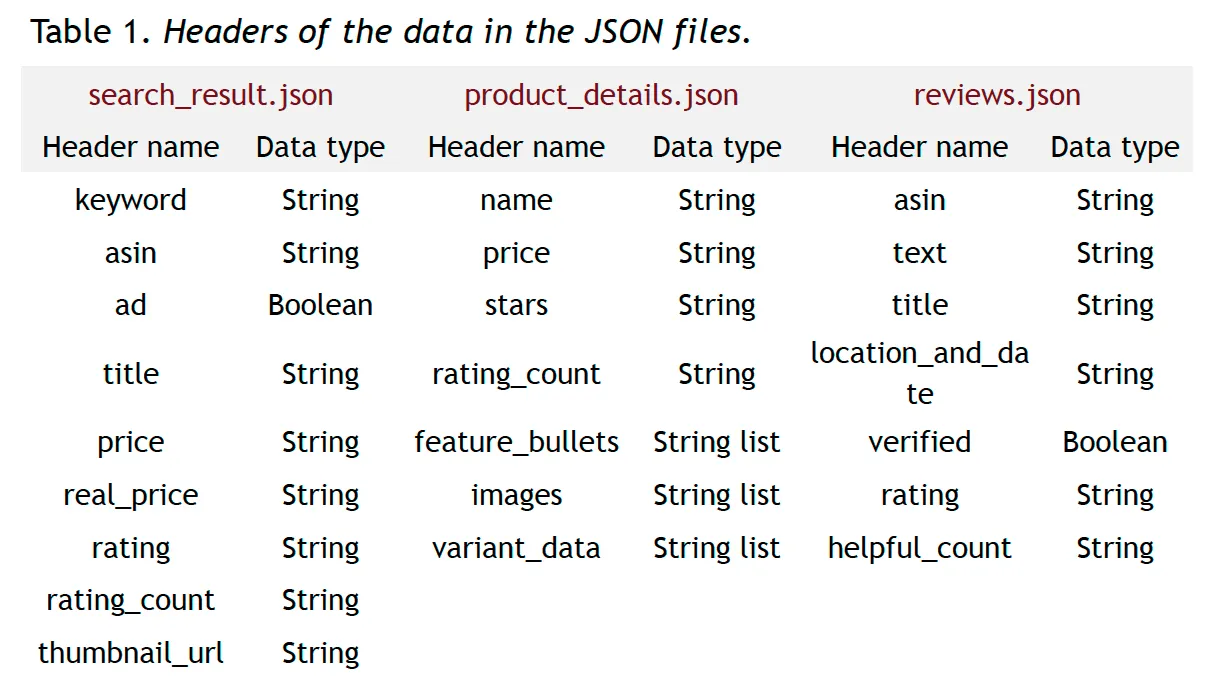
I first scraped 191 rows of search results from Amazon.com and the corresponding product information, and further scraped 6,605 rows of raw consumer review data for these 191 products on February 29th, 2024. The scraping process lasted six hours. Three JSON files were generated, storing the data of search results, detailed product information, and product reviews separately.
Data Preprocessing
- Step 1: Convert the JSON files to CSV files.
- Step 2: Delete null, duplicate and non-English data in the “text” column.
- Step 3: Import the dataset and read the column data.
- Step 4: Preprocess the data. The “nltk”, “word_tokenize” libraries are imported, and then the stopword list is created, and the data list corresponding to the “text” column was lowercase, tokenized, and lemmatized, in turn.
- Step 5: Replace words with similar meanings.
- Step 6: Build bigram.
Data Analysis
In this report, I used a combination of word frequency analysis (word clouds), sentiment analysis, network analysis, and topic modeling.
Results
Word Frequency Analysis & Word Cloud
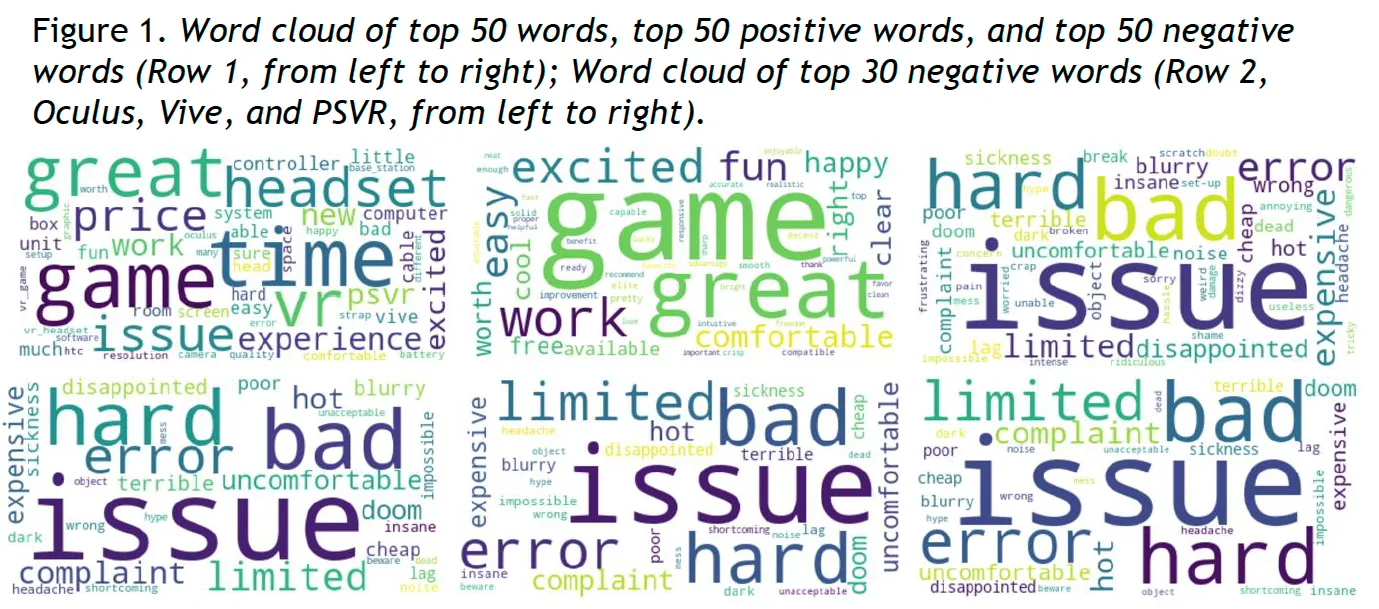
In terms of the top 50 words, there are more positive words than negative words. The most frequent words include time, game, great, vr, and headset. The most frequent positive words include game, great, work, excited, fun, easy, and comfortable. The most frequent negative words include issue, bad, hard, error, expensive, and limited. Highly mentioned model or product names that appear include Oculus, Vive (HTC), and PSVR (Sony).
Sentiment Analysis
DPVR’s average rating ranking (4) did not match the sentiment score ranking (1), which could be the result of 1) too little data or 2) insufficient support of Bing Liu’s lexicon for this sub-dataset. Therefore, the DPVR outcome data were excluded.
Vive has the lowest average rating and sentiment score, indicating that users are more likely to rate this brand’s products negatively compared to those of the other two brands.
Semantic Network Analysis
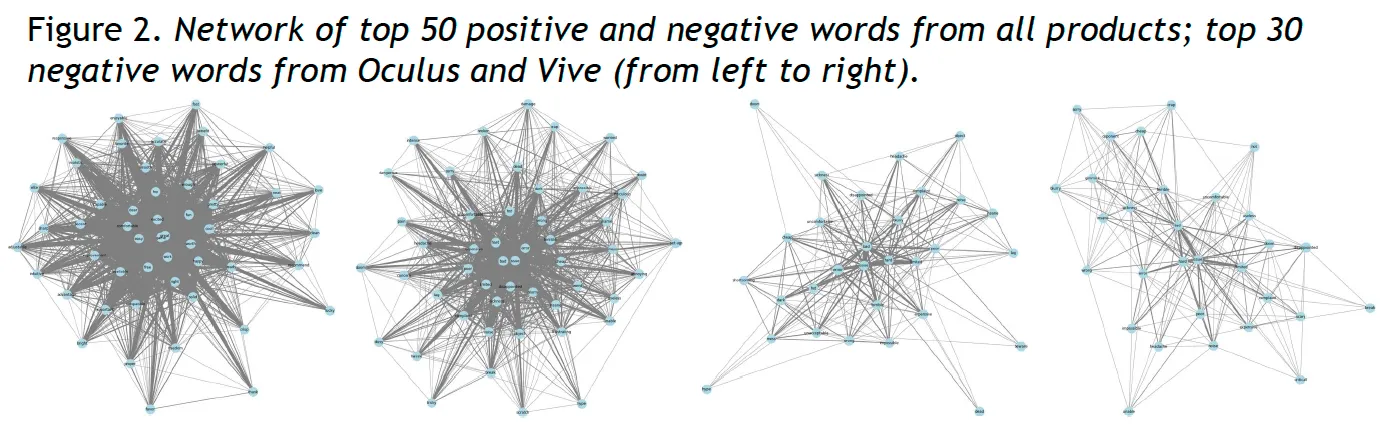
For “Oculus”, positive user experiences are highly related to “game”, “great”, “excited”, “easy”, “comfortable”, “work”, “cool”, and “happy”; while negative user experiences are highly related to “bad”, “issue”, “hard”, “limited”, and “error”.
For “VIVE”, positive user experiences are highly related to “game”, “great”, “excited”, “easy”, “comfortable”, “work”, and “cool”; while negative user experiences are highly related to “bad”, “issue”, “hard”, “limited”, and “poor”.
For “PSVR”, positive user experiences are highly related to “game”, “great”, “excited”, “easy”, “comfortable”, “work”, and “worth”; while negative user experiences are highly related to “bad”, “issue”, “hard”, “limited”, “expensive”, “blurry”, and “error”.
Topic Modeling
- The core consumer requirement for VR headsets is for a positive VR gaming experience. It further requires the virtual reality headset to be able to support mainstream VR games. However, current VR headset products are still unable to meet consumer requirements in terms of motion sickness relief and heat dissipation.
- Users make comparisons among different brands and reflect the “results” of comparisons publicly in their reviews. If they encounter some negative experiences, users will move on to other products.
- Consumers prioritize the difficulty of configuring a virtual reality headset product’s hardware. It is likely that the relatively low ratings and sentiment scores of “VIVE” headsets mainly come from difficulties in hardware configuration.
Retail Insights & Conclusion
- Manufacturers of VR headsets should identify the differences between novice users (Amazon consumers) and expert users (KOLs) and provide corresponding product models and services.
- VR headset manufacturers should prioritize support for VR gaming, which is reflected in 1) the compatibility of the operating system with mainstream VR games, 2) the compatibility of the handle buttons with games, and 3) the optimization of hardware rendering for VR games.
- VR headset manufacturers could compare their products to those of other brands and list the information on Amazon’s detail page. Such parameters should especially include the gaming-related parameters as well as information related to “cable, box, screen, battery, strap, and base station,” which are frequently mentioned by consumers.
- VR headset makers should be honest and not overhype their products to minimize the gap between the hype and the actual consumer experience.
- VR headset manufacturers should focus on reducing the difficulty for consumers to complete the hardware configurations.